About
Manifesto
Ether Wave Propaganda is a history of science blog that specializes in historiographical issues. It’s a niche blog aimed at people working in the academic disciplines of the History of Science and Science and Technology Studies. Those looking for general science blogs are welcome to follow along and comment, but may find some of the posts a little esoteric. We do have a “primer” (formerly “hump-day history”) series designed to offer a sophisticated but accessible introduction to various historical topics. The archive of primers can be found on the “Finding Aid” page.
The title of the blog is a reference to the 19th-century understanding of the transmission of electromagnetic energy (such as light) as taking place by means of waves traveling through a universally pervasive fluid called the “ether”. Ether also commonly refers to the sea of communication inhabiting overlapping radiowaves, or, more recently, the cyberspace of the internet. Propaganda is a variation on the word propagation, which is what waves do, they propagate. But it also refers to the fact that the blog welcomes opinionated commentary about what future scholarship in the history of science should look like.
A major aspect of this blog is its interest in opening up the “inside baseball” of historical scholarship. Many fine blogs present episodes from history to the public, while others are critical of popular representations of science and its history. This blog prefers an approach that opens up to scrutiny how little even professional historians know about and understand history, despite the fact that we have already made great strides. It aims to maintain candid conversations about the strengths and weaknesses of our portraits. This position is taken in the belief that, academically, it is much more exciting — both to ourselves and to outsiders — to confront problems and uncertainties, than it is to repeat what we think we already know.
Contributors
Will Thomas
Christopher Donohue
Will Thomas is currently a science policy analyst at the American Institute of Physics (AIP) in College Park, Maryland, where he writes for the FYI Science Policy Bulletin. However, he originally trained in the history of science, receiving a PhD in the subject from Harvard University in 2007. He worked as a postdoctoral associate historian at AIP from 2007 to 2010 and as a junior research fellow at the Centre for the History of Science, Technology, and Medicine, at Imperial College London from 2010 to 2013. From 2013 to 2016 he worked as a contract historian at History Associates, Inc., in Rockville, Maryland.
Thomas’s academic interests relate mainly to the physical, mathematical, engineering, and economic sciences, as well as to intersections between science and policy. His work focuses mainly on twentieth-century Britain and the United States. Views expressed on this blog are purely his own.

Twitter: @GWilliamThomas
Publications
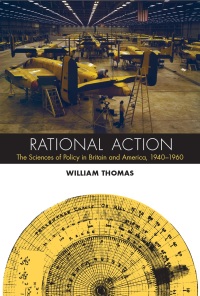
William Thomas, Rational Action: The Sciences of Policy in Britain and America, 1940–1960 (Cambridge, Mass.: The MIT Press, 2015). [MIT Press] [Amazon]
William Thomas, “Bureaucratic Reformism and the Cults of Sir Henry Tizard and Operational Research,” in Scientific Governance in Britain, 1914–79, edited by Don Leggett and Charlotte Sleigh (Manchester, UK: Manchester University Press, 2016), pp. 45–62.
William Thomas, “Useful History of Operations Research,” OR/MS Today 42/3 (2015): 18-22. https://www.informs.org/ORMS-Today/Private-Articles/June-Volume-42-Number-3/History-of-OR-Useful-history-of-operations-research
William Thomas, “Decisions and Dynamics: Postwar Theoretical Problems and the MIT Style of Economics,” MIT and the Transformation of American Economics, History of Political Economy 46 (2014) (annual suppl.): 295-314. http://dx.doi.org/10.1215/00182702-2716208
William Thomas, “Research Agendas in Climate Studies: The Case of West Antarctic Ice Sheet Research,” Climatic Change 122 (2014): 299-311. http://dx.doi.org/10.1007/s10584-013-0981-3
William Thomas, “The Mathematical Management of Uncertainty in Britain and America in the Second World War and After,” in Des Mathématiciens et des Guerres: Histoires de Confrontations (XIXe-XXe Siècle), edited by Antonin Durand, Laurent Mazliak, and Rossana Tazzioli (Paris: CNRS Éditions, 2013), pp. 71-79.
William Thomas, “Strategies of Detection: Interpretive Methods in Experimental Particle Physics, 1930-1950,” Historical Studies in the Natural Sciences 42 (2012): 389-431. http://dx.doi.org/10.1525/hsns.2012.42.5.389
William Thomas, “Operations Research vis-à-vis Management at Arthur D. Little and the Massachusetts Institute of Technology in the 1950s,” Business History Review 86 (2012): 99-122. http://dx.doi.org/10.1017/S0007680512000050
William Thomas and Lambert Williams, “The Epistemologies of Non-Forecasting Simulations, Part I: Industrial Dynamics and Management Pedagogy at MIT,” Science in Context 22 (2009): 245-270. (Will wrote most of this one.) http://dx.doi.org/10.1017/S0269889709002233
Lambert Williams and William Thomas, “The Epistemologies of Non-Forecasting Simulations, Part II: Climate, Chaos, Computing Style, and the Contextual Plasticity of Error,” Science in Context 22 (2009): 271-310. (Lambert wrote most of this one.) http://dx.doi.org/10.1017/S0269889709002221
William Thomas, “The Heuristics of War: Scientific Method and the Founders of Operations Research,” British Journal for the History of Science 40 (2007): 251-274. http://dx.doi.org/10.1017/S0007087407009508
William Thomas, “Selling OR: An Historical Perspective” OR/MS Today, October 2004. http://www.orms-today.org/orms-10-04/frselling.html
Christopher Donohue completed his PhD in History at the University of Maryland in 2013. He is currently splitting time between the Poletayev Institute for Theoretical and Historical Studies in the Humanities in Moscow and the National Institutes of Health in Bethesda, Maryland. He has broad interests in intellectual history, but focuses primarily on intersections between the social and biological sciences and political and legal thought. His work attempts to find new ways of uncovering the richness of ideas running throughout the historical record, and presenting them in analytically useful ways.
 Ether Wave Propaganda
Will, nice look! I like it. Michael
I am trying to find, chat with, or otherwise communicate with, the Michigan State Historian. Asearch of the web led me to this site.
Sorry to not be pertinent to what you are doing, but I’d appreciate it if whoever it is who knows him would please ask him to let him know I’m lookig for him, . (Matt Stanley?) or at least for the Michigan State Historian.
Bob Levy.
Hi Bob, Matt’s now at New York University and should be in their directory. If you’re looking for someone at MSU specifically you should look up the History Department’s web site; they have several historians of science.
One Giant Leap: A One Question Interview
I would like to invite you to participate in a one question interview that will be part of an article on The Secret of Newton. The one question is this:
What is the most significant “Giant Leap” in science history? Your answer to the question should be a single contribution that advanced a field of science the farthest in one giant leap.
Your response to the interview will be posted on The Secret of Newton blog along with contributions from other science bloggers I’m interviewing. Readers of will be polled for which among the contributions is the most significant scientific leap. The field of bloggers I’m tapping for this project includes:
The Deeps of Time
Physically Incorrect
Newton’s Ocean
Leave the Light on
Rocket Scientist
Arash’s World
Ether Wave Propaganda
Gumby the Cat
Nested Universe
Science 24×7
Science and Reason
Skulls in the Stars
The Questionable Authority
I’ve invited these people to participate because I’ve found a high caliber of thought in their blogs and truly respect their opinions. And I think that there is tremendous opportunity for debate.
I ask that submissions be posted in the comments to the “One Giant Leap Submissions” post at The Secret of Newton.
The reader’s choice for the best submittal will receive glory, honor and fame.
Much thanks!
-Brian
What a great site and I’m going to read much more than i have so far. We apparently view ourselves as independent from our history and thus objective in our sense of independence, this is clearly incorrect. There are other’s who hold an extremely subjective view which can only be articulated from a point of view of independence as well. My feelings are that we perceive ourselves independent at a biological level, which makes us independent from the environmental level, which makes us independent from reality at a philosophical level. Somewhere in the middle between an aspergers rationalism on one end or a bipolar emotionalism on the other end of a spectrum of human thinking is the truth. We are all slave to our biology it’s just who’s going to figure that out with a sense of intellectual rigor that I think is the challenge in this century. Keep asking the questions we need to learn how to contextualize much better and more rigorously.
[…] Ether Wave Propaganda as up a nice video of Schaffer on Latour, but the commentary on the question of agency is even more interesting. As EWP points out, the difference between Schaffer and Latour is programmatic, and as such it falls to the difference between description and explanation. In short, Latour is not attempting to explain things. The crucial point of dispute was that Latour allowed, by granting agency to microbes, that being in some sense correct could be a valuable asset in asserting one’s position. This position was intolerable to Schaffer, who argued (with Collins and Steven Yearley) that Latour was himself committing a specific form of Whiggish heresy called “hylozoism”, allowing nature to settle human disputes. For Schaffer, hylozoism, like grosser forms of Whiggism, hamstrung historical inquiry by short-circuiting the need to establish why evidence was considered credible in disputes: “Protagonists in dispute must win assent for … material technologies. Hylozoism suggests that the microbes’ antics can explain these decisions. Sociology of knowledge reckons that it is the combination of practices and conventions which prompt them, and these strategies get credit through culture. Only when credibility is established will any story about the microbes make sense” (190, my emphasis). […]
What a wonderful blog; I’m sure it’s an essential addition to the history of science community. I wonder, is there a suitable list for history of medicine blogs?
Jai
http://jaivirdi.wordpress.com/
Best. Blog. Ever.
I have been reading posts here with interest, especially the articles on tacit knowledge. Thanks for putting these up! I have written a little about the nature of history and its importance for its own sake on my own blog, (http://michaelakay.wordpress.com/2012/02/08/one-damn-thing-after-another-whats-the-point-of-studying-history/), and would be interested to receive comments or criticisms.
Thanks again!
I appreciate your efforts to understand and explain Szilard to the world and offer this piece about his unusual approach to science and politics. Best wishes, Bill Lanouette
Science and Public Policy, volume 33, number 8, October, pages 613–617, Beech Tree Publishing, 10 Watford Close, Guildford, Surrey GU1 2EP, England
History
The science and politics of Leo Szilard, 1898–1964: evolution, revolution, or subversion?
William Lanouette
Leo Szilard pursued physics, biology, and nuclear arms control in creative and impish ways by defy-ing traditional scientific and political methods. He worked within established disciplines to negate and reformulate both ideas and ideologies. Interacting with the likes of Albert Einstein, Enrico Fermi, and Bertrand Russell, Szilard pioneered discoveries in nuclear physics and advanced the cause of world peace. He challenged other Nobel laureates — and world leaders such as President Truman and Pre-mier Khrushchev — to rethink their assumptions and to reform their policies. Along with his keen insights and playful ingenuity, Szilard also em-ployed humor and blackmail.
William Lanouette is at 326 Fifth Street SE, Washington, DC 20003 USA; Email: wlanouette@comcast.net.
This is a revised version of a paper presented at the World Science Forum, Budapest, 10 November 2005. The author grate-fully acknowledges the Hungarian Academy of Sciences and Ploughshares Fund for support to attend the 2005 World Science Forum. The views in this talk are the author’s alone, and do not reflect those of the US Government Accountability Office, the Academy, or the Ploughshares Fund. HE PHILOSOPHER–HISTORIAN Thomas Kuhn proposed that science advances not by ‘evolution’ in small and steady increments, but by ‘revolution’. Science does not creep forward, he said; instead, it lurches in rare and dramatic ‘paradigm shifts’ from one world view to another (Kuhn, 1970; Chapman, 1995).
Yet consider a different explanation for scientific progress, one personified by the physicist, biologist, and arms-control activist Leo Szilard (1898–1964). Szilard worked at science in a third way: not by evolution or revolution, but by subversion. He ad-vanced by infiltrating, negating and reformulating what was already known by other scientists; by twisting conventional wisdom into unconventional discoveries.
Recalling his first encounter with Szilard in 1947, the Nobel laureate Jacques Monod said that
Many of the questions seemed very unusual, startling, almost incongruous. I was not sure I understood them all, especially since he in-sisted on redefining the basic problems in his own terms, rather than mine.1
Another Nobel laureate, physicist Hans Bethe, said Szilard was
one of the most intelligent people I have ever known. His mind worked quickly and pro-foundly, and he was able to come to ideas that most of us appreciated only after many hours of talk. This was his strength and, of course, also his weakness. He was always ahead of his time. His ideas often were expressed in paradoxes, and the paradoxes were not always understood. 2
T
Science and Public Policy October 2006 0302-3427/06/080613-5 US$08.00 © Beech Tree Publishing 2006 613
Science and politics of Leo Szilard
Szilardian science
Szilard was a visionary for both science and politics in the 20th century. In science, he devised the basis for information theory in the 1920s by imagining himself as ‘Maxwell’s Demon’, the imaginary imp in a classic thermodynamics puzzle. The Demon controlled molecules in a way that seemed to defy the Second Law.3 However, Szilard realized that to succeed the Demon had to use his memory, thus combining entropy with information.
Szilard thought up and patented the nuclear ‘chain reaction’ in the 1930s by defying Nobel physicist Ernest Rutherford’s proclamation that gaining en-ergy from atoms was “moonshine”. Rutherford had split atoms using alpha particles, but Szilard substi-tuted the newly discovered neutron to bombard atomic nuclei, adding the concept of a critical mass to envision self-sustaining chain reactions. With En-rico Fermi, Szilard co-designed the world’s first nu-clear reactor in 1939. When their invention first worked, in 1942, Szilard recalled, “I shook hands with Fermi, and I said I thought this day would go down as a black day in the history of mankind”.4
From the 1940s to the 1960s, Szilard took on mo-lecular biology, devising ways to clone mammalian cells and to explain negative feedback regulation.5
When Szilard saw in 1954 that biologists Philip Marcus and Theodore Puck were having trouble growing individual cells into colonies, he concluded that “since cells grow with high efficiency when they have many neighbors, you should not let a sin-gle cell know it’s alone”. This was no flippant ex-cursion into psychobiology. Rather, Szilard’s idea to use a layered feeder dish worked, while the open dish had not (Lanouette, 1992: 396–397).
Szilard is given credit by Monod for the negative-feedback idea behind his 1965 Nobel prize. “I have …recorded” in my Nobel lecture, said Monod, “how it was Szilard who decisively reconciled me with the idea (repulsive to me, until then) that enzyme induc-tion reflected an anti-repressive effect, rather than the reverse, as I tried, unduly, to stick to.”6
Szilard not only dreamt up bright ideas, he also loved to devise new and novel institutions. He founded the Association for Scientific Collaboration in 1939 to fund chain-reaction research with Fermi (Lanouette, 1992: 187). He helped Jonas Salk estab-lish the Salk Institute for Biological Studies, encour-aging that it study both basic science and the social problems that science creates.7 With CERN as his model, Szilard proposed the European Molecular Biology Organization (EMBO), which thrives today in Heidelberg, Germany.8
William Lanouette, writer and public policy analyst, special-izes in the politics of nuclear energy and nuclear weapons. He is the former Washington Correspondent for The Bulletin of the Atomic Scientists and has written freelance articles for many publications including The Atlantic, The Economist and Scientific American. He has written (with Bela Silard), Genius in the Shadows: A Biography of Leo Szilard. Lanouette earned an AB in English at Fordham University, and MSc and PhD degrees in politics (comparative govern-ment) at the London School of Economics and Political Sci-ence. He is currently a senior analyst for energy and science issues at the US Government Accountability Office.
Szilardian politics
A true subversive, Szilard approached politics in the same disruptive and creative way. Behind his politi-cal drive was a “narrow margin of hope” that he gained as a child and embodied throughout his life. From this he determined that “it is not necessary to succeed in order to persevere”.9 In Budapest, during the 1919 Bela Kun Hungarian Soviet Republic, Szilard founded a socialist students association to help clarify political and economic issues.10 In Lon-don, in the 1930s, Szilard helped organize the Aca-demic Assistance Council to aid refugee scholars.11 He also proposed enlisting Nobel laureates to protest Japan’s invasion of Manchuria, the first time this august group was politicized in this way (Weart and Szilard,1978: 36–38; Lanouette, 1992: 141).
Szilard’s best known political efforts involved his mentor and friend, Albert Einstein. In New York, in 1939, Szilard proposed and drafted a letter from Einstein to President Franklin D Roosevelt that warned about German nuclear weapons research and urged a US counter-effort. Why Einstein? Szilard had befriended Einstein in Berlin in the 1920s, and the two developed several joint patents for an electro-magnetic pump. Einstein was known to Roosevelt, while Szilard was not. Also, as Szilard put it, “The one thing most scientists are really afraid of is to make a fool of themselves. Einstein was free from such a fear and this above all is what made his posi-tion unique on this occasion”.12
Their letter prompted Roosevelt to convene a fed-eral Advisory Committee on Uranium (with Hungar-ian physicists Eugene Wigner, Edward Teller, and Szilard as members) that promised money for Fermi and Szilard to conduct chain-reaction experiments at Columbia University. When this funding from Washington had not materialized by the spring of 1940, Szilard enlisted Einstein in a little-known ef-fort at political blackmail. He drafted for Einstein a letter warning the White House that, if those funds were not forthcoming, Szilard would publish a paper detailing just how a chain reaction in uranium could work. Soon, Fermi and Szilard received their money (Lanouette, 1992: 216).
Szilard drafted another little-known Einstein letter to Roosevelt in March of 1945, this time seeking to influence post-war nuclear arms control. When Roosevelt died in April, before seeing the letter, Szilard called on the Truman White House and was sent, in May, to meet with the new president’s atomic advisor (and soon Secretary of State) James 614 Science and Public Policy October 2006
Science and politics of Leo Szilard
F Byrnes. Szilard brought along chemist Harold Urey, pitting two scientists who had made the bomb and wanted to stop it against the politician who could not wait to use it (Lanouette, 1992: 259–266). The two scientists left the meeting frustrated by Byrnes, who saw the bomb as a way to appease the Congress and intimidate Soviet Premier Joseph Stalin.
Undeterred, Szilard helped in June to draft the Franck Report by Manhattan Project scientists urg-ing an A-bomb demonstration (Franck et al, 1945), before dropping it on cities (Lanouette, 1992: 267–269). When that was ignored, Szilard organized a petition to Truman in July signed by 155 Manhattan Project scientists that urged the president to weigh his moral responsibilities. However, the Army de-layed the petition, and after the war classified it “Se-cret”. It was finally declassified in 1961, and first published in 1963, a year before Szilard’s death (Lanouette, 1992: 259–278).
It is ironic that Szilard suffered from atomic se-crecy, which he had invented. In the 1930s, when Szilard feared that German scientists would recog-nize what he had found out about chain reactions, he urged colleagues not to publish their nuclear re-search — a heresy in science at the time. Yet, once the Army took over in 1942, secrecy became law. After the war, Szilard said the most powerful weapon to result from the Manhattan Project was not the A-bomb but the “SECRET” stamp (Lanouette, 2004).
Once A-bombs leveled Hiroshima and Nagasaki, Szilard led American scientists to lobby Congress for civilian control of the atom. Beginning in 1945, he urged direct talks between US and Soviet scien-tists to curb a nuclear arms race. Scientists should share ideas, he insisted, because they could bring much-needed reason to complex policy matters.
In 1947, Szilard wrote an open letter to Stalin, urging nuclear restraint and proposing radio broad-casts to each others’ citizens by US and Soviet leaders. The same year, Szilard wrote his political satire “My trial as a war criminal” (Szilard, 1949) to dramatize that scientists are responsible for their creations. When this story was republished in 1961, the Russian nuclear physicist Viktor Adamsky read it, then translated it for his colleague Andrei Sakharov. According to historian Richard Rhodes (1995: 282), Sakharov took Szilard’s responsibilities to heart and began his own courageous crusade to halt the arms race he had advanced so brilliantly.13
In 1960, Szilard advocated a new way to coerce public officials to do the right thing: bribery. In The Voice of the Dolphins, a political satire that correctly predicted how the US–Soviet nuclear arms race would run down in the 1980s, Szilard speculated that a fictional research institute might raise money, edu-cate the public, and bribe corrupt officeholders to re-tire, while rewarding honest ones who make politically tough decisions. “The book is not about the intelligence of the dolphin,” Szilard said, “but about the stupidity of man.” It was both playful and dead serious; much like Szilard himself (Szilard, 1992).
Also in 1960, Szilard became playful and serious during a private meeting with Premier Nikita Khrushchev in New York City. During their two-hour conversation, Szilard gained the Soviet leader’s assent for a Moscow–Washington hot line to help prevent accidental nuclear war. As a gift, Szilard brought Khrushchev a new razor and promised to send him blades as long as there is no war. “If there is war,” said Khrushchev, “I will stop shaving. Most other people will stop shaving, too.” (Lanouette, 1992: 417–420)
In his politics as in his science, Szilard loved to create new institutions. In 1946, Szilard joined with Einstein, Urey, and Bethe in an Emergency Commit-tee of Atomic Scientists to educate the public about the dangers from A-bombs and a nuclear arms race. In 1957, Szilard joined the first Pugwash Conference on Science and World Affairs, and that fall urged that these talks among scientists be kept private, and not be expanded to a mass movement as co-founder Bertrand Russell preferred. Szilard’s view prevailed, assuring a back-channel dialogue for the nuclear superpowers. The Pugwash Conferences, and their leader Joseph Rotblat, received the 1995 Nobel Peace Prize for continuing efforts to hold science re-sponsible for its creations.
In April 1961, a week after the CIA’s inept inva-sion at Cuba’s Bay of Pigs, Szilard was elected to the National Academy of Sciences, and he quickly tried to politicize its members. He invited academicians to sign a petition to President Kennedy condemning his administration’s actions and policies.
When A-bombs leveled Hiroshima and Nagasaki, Szilard led American scientists to lobby Congress for civilian control of the atom: scientists should share ideas, he insisted, because they could bring much-needed reason to complex policy matters
Only one-sixth of the Academy members signed,14 and an esteemed friend, physicist James Franck, censured Szilard. Franck had appreciated Szilard’s moral and political direction on the Franck Report, but this time he drew a harsh distinction. Franck objected that “scientists as a class believe that their scientific reputation is a proof that they are also experts in political reasoning”. He warned that “we endanger our influence in these particular ques-tions if we speak up as a group in matters not directly connected with our profession”.15
This candid advice led Szilard to abandon petitions
Science and Public Policy October 2006 615
Science and politics of Leo Szilard
as a way to influence political decision-makers. Petitions, Szilard realized, were for outsiders. How, he wondered, could he become a Washington in-sider? (Lanouette, 1992: 435–438). Szilard’s answer led him to his first and only popular and democratic political effort. In 1962, he founded the Council for a Livable World to raise money for US Senators who favored arms-control treaties. By Szilard’s cal-culus, all states had two Senators, so votes came cheapest by supporting campaigns in the least popu-lous states.
The Council’s first successful candidate was Senator George McGovern from South Dakota. To-day the Council thrives by supporting candidates from all states and the House of Representatives as well. It is America’s first political action committee for arms control and disarmament.
Two questions
For us today, Szilard’s career raises two questions about science and politics. Are scientists more effec-tive working inside or outside their professional and political establishments? How can policy-makers use scientists most effectively?
To the first question I would answer that scientists can influence policy-makers from both inside and outside their governments. J Robert Oppenheimer was famously an insider during and after World War II, but was banished because his views crossed the ambitions of other inside scientists and policy-makers — notably Edward Teller and President Eisenhower’s nuclear adviser and Atomic Energy Commission chairman, Lewis Strauss. Teller played an insider role during his long and influential career in America, advising allies in the congressional Joint Committee on Atomic Energy, the US Air Force, the Atomic Energy Commission, the Federal Bureau of Investigation, and the White House.
Another insider among the Hungarians in the Manhattan Project was John von Neumann, who be-came a member of the Atomic Energy Commission. A third was Eugene Wigner, who analyzed and ad-vocated civil-defense schemes for the National Academy of Sciences and for New York Governor Nelson Rockefeller. Wigner said in 1983 that as a young man he went into science because he knew that as a Jew he would never be prime minister (Wigner, 1992: 287–297).16
Still, outsiders like Szilard have also shaped pub-lic policy. Philosopher Bertrand Russell helped cre-ate both the Pugwash Conferences and the British peace movement. Physicist Ralph Lapp publicized the dangers of atomic testing with his expose of the Lucky Dragon, a Japanese fishing boat whose crew suffered from radioactive fallout. Chemist Linus Pauling roused the worldwide opposition to nuclear testing that led to test-ban treaties. “I think that sci-entists have a special responsibility,” Pauling said. “All human beings, all citizens, have a responsibility for doing their part in the democratic process. But almost every issue has some scientific aspect to it, and this one of nuclear war, or war in general, is of course very much a matter of science.”17
Princeton University physicist Frank von Hippel notes that influencing policy-makers involves both activists who raise, shape, and amplify policies and analysts who study and explain the science and technology behind them. Working together can be a winning combination, von Hippel said, citing the Anti-Ballistic Missile Treaty in 1972 and defeat of the Strategic Defense Initiative (SDI or ‘Star Wars’) in the 1980s (von Hippel, 1986).18
To the second question, about how policy-makers can use scientists most effectively, it is worth recall-ing Winston Churchill’s dictum that “science should be on tap, not on top”. Physicist I I Rabi was a mem-ber of the Atomic Energy Commission’s General Advisory Committee and also served on the Presi-dent’s Science Advisory Committee. Being inside the government is always useful, Rabi has said, even when your advice is ignored. Still, Rabi told fellow Nobel laureate Leon Lederman: “Advisors come and go. Power in this country belongs not to advisors, but to elected officials. If you scientists want your advice to be heeded, get elected! Run for office!” (Lederman, 1988: 225, original emphasis).
Working in and out of government, Hans Bethe continued his criticism of the nuclear arms race as a White House adviser and by publicly urging fellow scientists to boycott work on weapons of mass de-struction. Joining with physicist Richard Garwin, Bethe publicly revealed scientific problems with the anti-ballistic missile system, as a way to end its de-velopment. The two also undermined the SDI by pointing out that Teller’s dreams for an X-ray laser to shoot down intercontinental missiles would not work as proposed because his calculations ignored a simple fact: the earth is round (Garwin, 2005).
Several Russian scientists besides Sakharov have publicly opposed their government’s policies, among them Yuri Orlov, who founded a Moscow chapter of Amnesty International and the first Helsinki Watch, and Evgeny Pavlovich Velikhov.
Conclusion
A final question concerns us now. Where are the Szilards of today? Who will risk failure to do the right thing? Who will pursue that “narrow margin of hope”? One legacy to recognize today’s policy-minded scientists is the American Physical Society’s Leo Szilard Lectureship Award. Since 1975, this award has honored outstanding accomplishments by scientists working “for the benefit of society in areas such as the environment, arms control, and science policy”.19
In conclusion, Szilard’s message for scientists today is: try anything once. Work by evolution, revolution, and subversion! In a word, experiment!
616 Science and Public Policy October 2006
Science and politics of Leo Szilard
Notes
1. “Foreword” in Feld and Szilard (1972: xvi). Jacques Monod shared the 1965 Nobel Prize for physiology or medicine with Francois Jacob and Andre Lwoff “for their discoveries con-cerning genetic control of enzyme and virus synthesis” (Hargittai, 2002: 39, 328).
2. Hans Bethe interview, 21 November 1985, in Lanouette (1992: xix) (page references are identical for 1992 and 1994 editions). For personal and historical context on Szilard’s life, see Frank (2004).
3. The Second Law of Thermodynamics states that no cyclic process is possible in which heat is absorbed from a reser-voir at a single temperature and converted completely into mechanical work. James Clerk Maxwell (1871), in Theory of Heat, posed a way to defy this law by having an imaginary, impish creature — Maxwell’s Demon — manipulate mole-cules without expending any energy. To do this, Szilard rea-soned, the Demon had to use his memory, thus linking the concepts of entropy and information (Lanouette, 1992: 61–62.
4. CBS Reports interview, broadcast 2 April 1960, transcript page 47 in Leo Szilard Papers, Mandeville Special Collections, Uni-versity of California, San Diego. See Weart and Szilard (1978: 146). Attribution in Source Notes to Mike Wallace interview, WNTA-TV, 27February 1961.See also “See itnow”, November 1952, with Edward R Murrow (Lanouette, 1992: 245).
5. For more on Szilard’s transition from nuclear physics to mo-lecular biology, see Pallo (1998: 141–147; Lanouette (1990).
6. Monod in Feld and Szilard (1972: xvii).
7. “Memorandum to Cass Canfield by William Doering and Leo Szilard (January 11, 1957)” (Feld and Szilard, 1972: 505–524). Working behind the scenes, Szilard helped arrange the funding, select the site in La Jolla, California, and enlist the first fellows.
8. See, for example, Szilard to C F von Weizsacker, 14 Janu-ary 1963 (CERN #1 cc. To Weisskopf, CERN Archive File 20683). See also CERN Report dated 20 August 1963 (File 6808, CERN no 1) and Dakin to Weisskopf, 19 July 1963 (CERN book #1). Szilard helped raise support for EMBO through his approaches to the French Government and the Volkswagen Foundation.
9. Szilard wrote that he gained a “narrow margin of hope” to save mankind after reading the Hungarian epic poem by Imre Madach, The Tragedy of Man (Weart and Szilard,1978: 3; footnote 1).
10. Both before and after World War I, Szilard had attended the Galilei Circle, a cultural movement of free-thinking students in Budapest, which was suppressed in 1919 (Lanouette, 1992: 45–46).
11. Today, the Academic Assistance Council (AAC) survives as the Society for the Protection of Science and Learning. AAC’s archives are in the Bodleian Library, Oxford (Lanou-ette, 1992: 117–127).
12. Szilard note for interview, 18 April 1955 (the day of Einstein’s death) (Weart and Szilard (1978: 83; Lanouette, 1992: 200).
13. “We were amazed by [Szilard’s] paradox”, Rhodes (1995) quotes physicist Viktor Adamsky, a colleague of Andrei Sakharov. “You can’t get away from the fact that we were developing weapons of mass destruction. We thought it was necessary. Such was our inner conviction. But still the moral aspect of it would not let Andrei Dmitrievich [Sakharov] and some of us live in peace.” Adamsky later translated and published a Russian edition of Genius in the Shadows (Lanouette, 1992).
14. Among the signers were Szilard’s friends and colleagues, in-cluding Edward Condon, Max Delbruck, Salvador Luria, Hermann Muller, Harlow Shapley, and Victor Weisskopf.
15. Franck to Szilard, 21 May 1961, Franck Papers (Joseph Re-genstein Library, University of Chicago); Lanouette (1992: 437-438).
16. Eugene Wigner interview, 12 October 1984. For background on the Teller–Strauss efforts against Oppenheimer see McMillan (2005). Wigner’s science/prime minister remark was made during a personal interview with science historian Gabor Pallo.
17. Linus Pauling interview with Harry Kreisler, 18 January 1983 (Institute of International Studies, University of California, Berkeley). Pauling’s six-year, unrelenting campaign against nuclear testing led to the Limited Test Ban Treaty, which took effect on 10 October 1963, the day it was announced that Pauling would be awarded the Nobel Peace Prize for 1962.
18. See also Primack and von Hippel (1974) and von Hippel (1991). For a recent example of science and decision-making, see Jacobs et al (2005).
19. See the American Physical Society entry for prizes and awards at , last ac-cessed 10 October 2006. Among the scientists honored for their Szilardian spirit are John A Simpson, Evgeny P Velikhov, Roald Z Sagdeev, Herbert F York, Ray Kidder and Roy Woodruff, John H Gibbons, Kurt Gottfried, Robert H Williams, Thomas Cochran, Carl Sagan, Kosta Tsipis, David R Inglis, Andrei Sakharov, Wolfgang Panofsky, Henry Kendall, Hans Bethe, Sidney Drell, Sherwood Roland, Matthew Meselson, Richard Garwin, and Bernard Feld.
References
Chapman, Gary 1995. Simplify, simplify. Los Angeles Times, 28 December.
Feld, Bernard T and Gertrud Weiss Szilard eds. 1972. The Col-lected Works of Leo Szilard. Scientific Papers. Cambridge MA and London UK: MIT Press.
Franck, James, Donald J Hughes, J J Nickson, Eugene Rabino-witch, Glenn T Seaborg, Joyce C Stearns and Leo Szilard 1945. A report to the Secretary of War (The Franck Report). Re-printed in Morton Grodzins and Eugene Rabinowitch eds. 1963. The Atomic Age. New York and London: Basic Book Inc.
Frank, Tibor 2004. Ever Ready to Go: theMultiple Exiles of Leo Szi-lard. Berlin: Max-Planck-Institut fur Wissenschaftsgeschichte.
Garwin, Richard L 2005. The secret Hans. Paper presented at Celebrating an Exemplary Life, Cornell University, 18 Septem-ber. See The Garwin Archive at , last accessed 10 October 2006.
Hargittai, Istvan 2002. The Road to Stockholm: Nobel Prizes, Sci-ence, and Scientists. Oxford: Oxford University Press.
Jacobs, Katharine, Gregg Garfin and Melanie Lenart 2005. More than just talk: connecting science and decisionmaking. Envi-ronment, 47(9), November, 6–21.
Kuhn, Thomas S 1970. The Structure of Scientific Revolutions, 2nd edn., enlarged. Chicago: University of Chicago Press.
Lanouette, William 1990. Leo Szilard and post-war science: from nuclear physics to molecular biology. Paper presented to The History of Science Society and American Historical Associa-tion, Washington DC, 29 December.
Lanouette, William (with Bela Silard) 1992. Genius in the Shad-ows: a Biography of Leo Szilard, the Man Behind the Bomb. New York: Scribner (and, in 1994, Chicago: University of Chicago Press,
Lanouette, William 2004. Leo Szilard: baiting brass hats. In Remembering the Manhattan Project: Perspectives on the Making of the Atomic Bomb and its Legacy, ed. Cynthia C Kelly, pp. 73–77. Hackensack NJ: World Scientific.
Lederman, Leon M 1988. Science advising. In Science and Tech-nology Advice to the President, Congress, and Judiciary, ed. William T Golden New York: Pergamon Press.
McMillan, Priscilla J 2005. The Ruin of J. Robert Oppenheimer and the Birth of the Modern Arms Race. New York: Viking.
Pallo, Gabor 1998. To save the world: Szilard’s biology and phi-losophy. In Leo Szilard Centenary Volume. Budapest: Eotvos Physical Society.
Primack, Joel and Frank von Hippel 1974. Advice and Dissent: Scientists in the Political Arena. New York: Meridian, New American Library.
Szilard, Leo 1949. My trial as a war criminal. University of Chi-cago Law Review, Autumn. Reprinted in Szilard (1992).
Szilard, Leo 1992. The Voice of the Dolphins, and Other Stories. Stanford CA: Stanford University Press (originally published in 1961, New York: Simon and Schuster).
von Hippel, Frank 1986. Finding common ground: analysts and ac-tivists must work together. Nuclear Times, March/April, 19–20.
von Hippel, Frank 1991. Citizen Scientist. New York: Touchstone, Simon and Schuster.
Weart, Spencer R and Gertrud Weiss Szilard eds. 1978. Leo Szi-lard: His Version of the Facts. Cambridge MA and London UK: MIT Press.
Wigner, Eugene Paul 1992. The Recollections of Eugene Wigner (as told to Andrew Szanton). New York/London: Plenum Press.
Science and Public Policy October 2006 617
Yours pieces about Bernal show how complex he was. His fascination with psychoanalysis makes him even more difficult – objective scientists are not usually good cases for seeking the self. And what about “For Intellectual Freedom” and Ritchie Calder, another lefty.
Then see my scienceandartblog.com
Michael Boulter
I’m really committed to the future of science and regard history as a critical component of any sustained revival of predictive fundamental science. This does assume history itself transitions to a science which feasibly is as hard a problem as that facing fundamental science itself. One does not know, but to find this blog and so many first class people apparently committed to doing whatever it takes (whether or not they would characterize things the way I do) is immensely reassuring.
I’ve got a funny history for myself. I have been in pretty much complete isolation for a couple of decades, in which I have focused on science in a way that admittedly had neither the foundations for undertaking such a direction, nor – as isolation would suggest – involved ad-hoc research by me. In fact, trying to make a virtue of a sin, perhaps – I made that into a discipline. Thinking, well, if this is ever going to be of any use to anyone, then purity is better. If it’s not useful, then at least be useful in allowing that to come clear real fast for them!
So, I’ll read here, and if I think I was right in my first impressions, I would like to try to add value, in a way that is clear and useful (even only exposing uselessness in a transparent way). For that reason I’m not going to read your ‘finding aid’. If that’s is unacceptable, obviously please just drop a line, and I will go away.
[…] best references on the subject: Ether Wave Propaganda (EWP), a history of science blog created by Will Thomas in 2008 co-animated since then with his colleague Christopher Donohue. Their posts deals with […]
[…] working on the history of cooking and food processing to take a look at a recent blog post by Will Thomas, like me a historian of science and […]
[…] As I was gathering references for the post, I realize how much historians and sociologists have focused on public statistics. I don’t really buy the idea that governments alone are responsible for the production of economic data. Nor am I a priori willing to consider economists’ growing reliance upon proprietary data produced by IT firms to research as “unprecedented.” Several of the following references on private economic data collection were suggested by Elisabeth Berman, Dan Hirschman, and Will Thomas. […]
[…] As I was gathering references for the post, I realized how much historians and sociologists of economics’ focus is on the production of public data, and their use in state management and discourse. I don’t really buy the idea that governments alone are responsible for the rise in the production of economic data in the last centuries. Nor am I a priori willing to consider economists’ growing reliance upon proprietary data produced by IT firms as “unprecedented.” Several of the following references on private economic data collection were suggested by Elisabeth Berman, Dan Hirschman, and Will Thomas. […]